

By Sofya Firsakova and Shiri Atsmon
This month’s blog contains a number of ways you can reduce the environmental impact your clothing choices have. The biggest culprit we address is fast fashion, which refers to clothes that are produced quickly and cheaply in response to changing trends. In turn, they are also disposed of just as easily.
The facts below underscore the depth of our clothing waste problem.
A Quick Overview
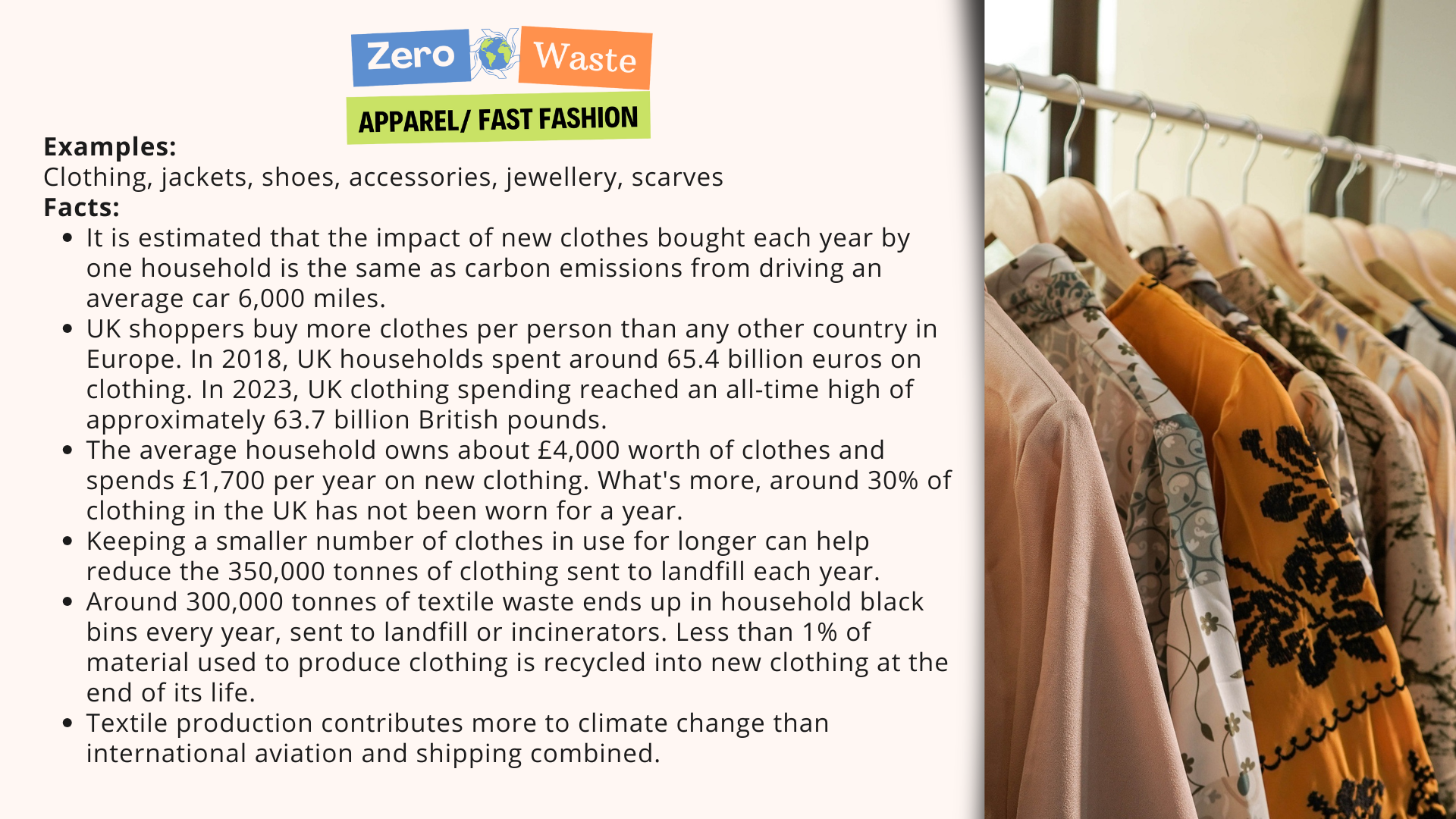
The Cost of Convenience
The allure of the options sprawled in front of us is hard to resist, especially with the rise of TikTok Shop and sites like AliExpress. These platforms make fast fashion more enticing, accessible and affordable than ever.
Unfortunately, the price tag on those ‘too good to be true’ deals is, indeed, too good to be true. The problem is twofold, with both huge environmental and ethical issues arising that are hard to ignore. Textile production contributes to more climate change than global aviation and shipping combined. It adds to water pollution and waste and relies on hidden supply chains, with workers often facing exploitative conditions. The clothes themselves very often look and feel cheap, contributing to them being disposed of sooner. We compound the problem by buying too many clothes, but to make things worse, we’re not even wearing them! Around 30% of clothes in the UK have not been worn for over a year.
What Steps Can You Take?
The Simplest Solution – Choosing the Clothes You Already Have
Even the most sustainably made garments use resources for production. As the root problem lies in the excess in which we buy clothes, the most environmentally friendly solution is choosing clothes already in our closets. In fact, research by the Waste and Resource Action Programme shows that wearing clothes for just 9 months longer in the UK than the average length of wear would reduce the water and waste footprints by 20-30% per item. Truth be told, this idea is far from groundbreaking. However, we do often forget we even own certain pieces. Looking at your wardrobe and taking the time to find new combinations can inspire you.
Learning to sew is a great way to make your wardrobe last longer and feel more exciting. Even without a sewing machine, a thread and a needle can go a long way. Mend, cinch or redesign a t-shirt you love to last longer, or tie your favourite silk scarf into a top. Check out Repair What You Wear for inspiration
and tips, or go to a local repair shop.
Creating a Circular Economy
EBay, Vinted and Depop are amazing apps for both selling and buying preloved clothes, creating a circular economy. Uploading new listings only takes about 2 minutes. With 80% of clothes donated to charity shops ending up at landfill, selling can be a better alternative to donating as you know your clothes have gone to someone who will love them. It’s also the best place to find the most beautiful, rare pieces. You can filter clothes by price, condition (there are many new clothes on Vinted!), brand, clothing type and more. Not only are the clothes often better quality and sustainably sourced, but they are also far cheaper.
Can’t find what you wanted on Vinted? Try renting instead. This is especially amazing for young children, who constantly grow out of their clothes, and for special occasions, where finding preloved options may be harder. Renting clothes is a growing industry. Many companies even offer monthly fees, allowing customers to constantly renew their wardrobes.
Charity shops are also an amazing advantage of living in England and the ones in Barnet are amazing! The clusters of charity shops, such as in Finchley, Crouch End and High Barnet, make it very simple and fun to find items you need and donate old belongings.
The Last Resort…
If you do find you need new items that you simply can’t find elsewhere, let’s say work trousers, buy clothes from sustainable brands and ensure they are well-made. Check the composition of the clothes you buy. Good-quality materials will look better and allow you to keep your clothes longer.
A Quick Summary
This slide is a useful summary of the actions you can take. Starting with refusing items composed of plastic, it efficiently summarises the steps we can follow to be more sustainable with our fashion choices.ate Waste” websites for practical and helpful ideas and food-waste recipes.
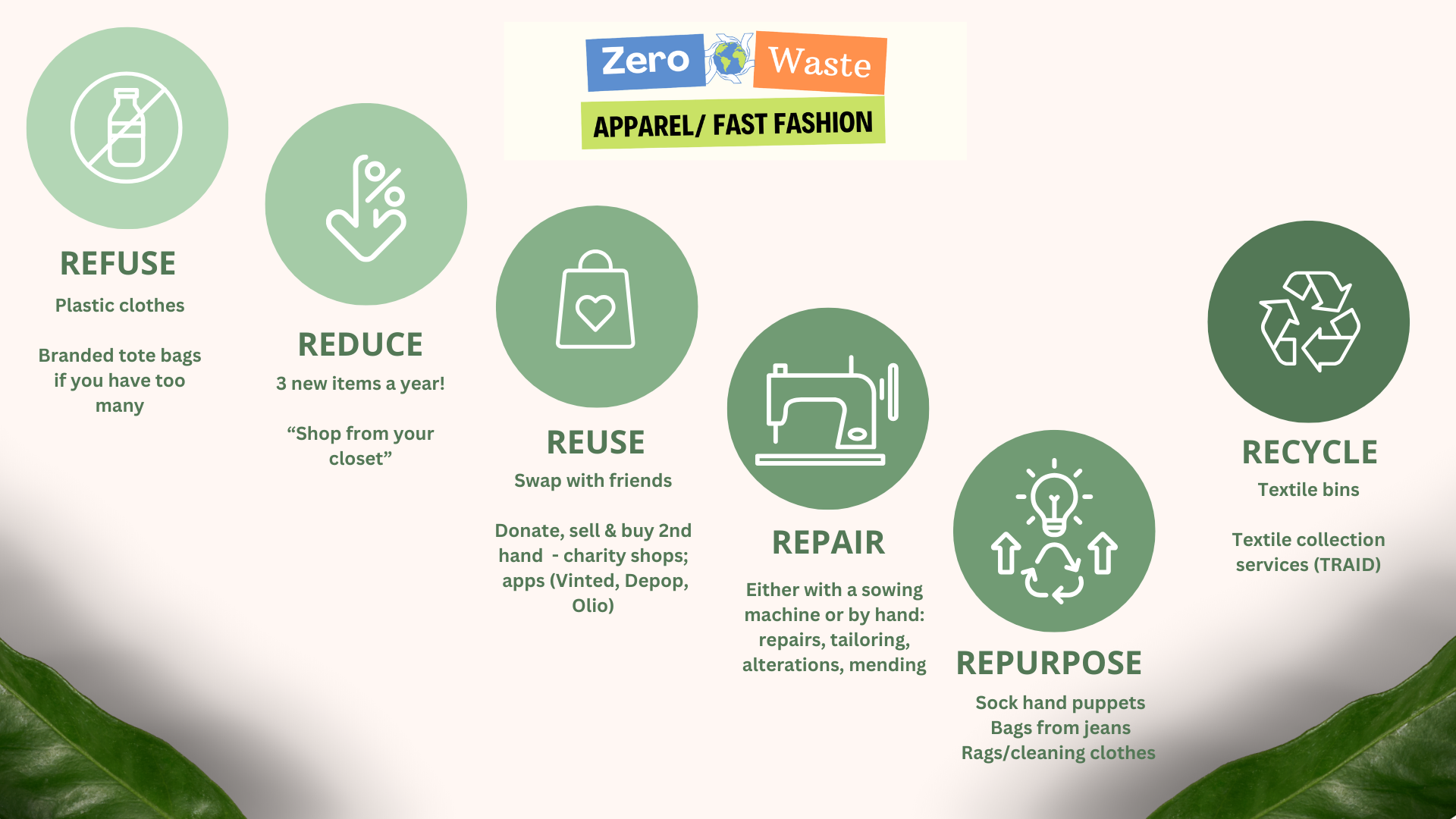
Tune in to our very own zero-waste webinar. Fast forward to minutes 1:03 to 1:010 where we discuss the above ideas in more detail:
Engage Your Community
Communities are the most powerful drivers of change. Below are some ideas of how to share your passion for sustainability, with a focus on fashion, with others.
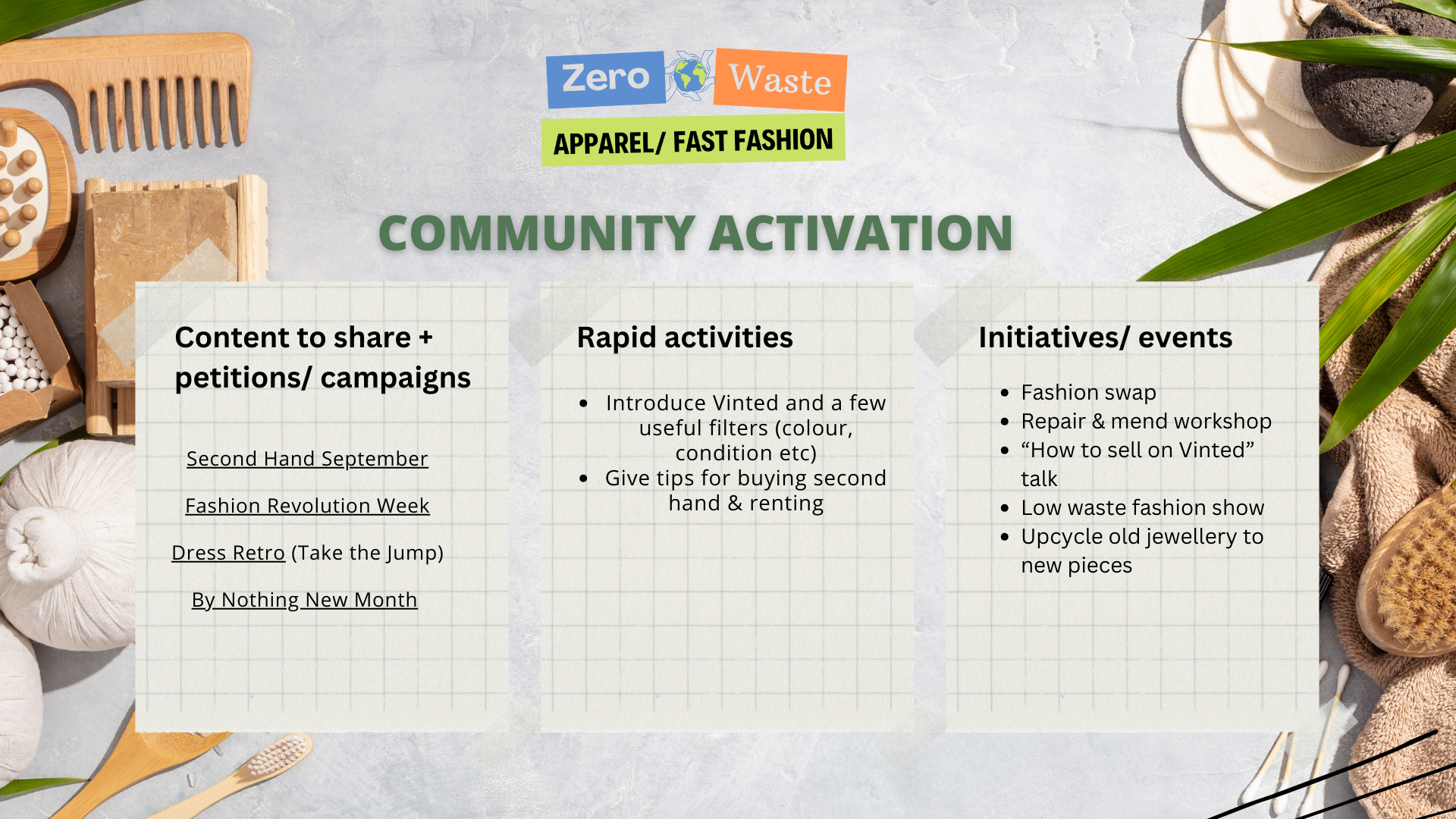
Further ideas/ links to involve your community include:
- Fashion swap: Hold a ‘Swap party’ and invite all your friends to come along for a mutual freshen up of your wardrobes.
- Celebrate “Mend in Public Day“, run a repair & mend workshop, join a ‘Make and Mend’ group, or attend a course or workshop on repairing or upcycling. You can also host a Mending Workshop: teach your community how to mend to extend the life cycle of their clothing. If you can’t find a person who can show others how to do this in your community, please reach out to one of the members in Barnet’s Sustainable Fashion Circle
- Host a “How to sell on Vinted” talk
- Organise a low waste fashion show
- Upcycle old jewellery to new pieces
- Give tips for buying second hand & renting
- Host a workshop upcycling old clothes into new projects
- Print and share this educational poster
- Get inspired by 2024’s Sustainable Fashion Week’s community programme
Barnet, London & National campaigns and specialist websites
We’ve rounded up some helpful resources which provide expert guidance on reducing your apparel carbon footprint. Look through these for actionable advice and inspiration.

The links for the campaigns mentioned above:
- Fashion Revolution Week Tuesday 22nd – Sunday 27th April 2025, with many organising a Fashion Revolution event for their community.
- Mend In Public Day – 26th April 2025
- Sustainable Fashion Week 27th September – 5th October 2025 aims to bring people together to drive change, inspiring people to think globally but act locally. Their site has a number of useful, eye-catching resources. For example, take a look at their Fashion Industry Overview page and digital handbook made for.
- Second Hand September was started by Oxfam in 2019, aiming to inspire people to only buy second-hand clothes throughout the month. If everyone participated in Second Hand September, the impact would be significant: 204 million kilograms of clothing waste and 25 billion gallons of water could be saved.
- Buy Nothing New Month is a similar idea, encouraging people to not buy anything apart from essentials in November.
- Dress Retro is a campaign by Take the Jump, encouraging people to limit the amount of clothes they buy to three new pieces a year.
- Follow Barnet’s own sustainable fashion guru Penny on Instagram @threadsforapenny
- Barnet’s Sustainable Fashion Circle is a newly formed WhatsApp group which connects people in Barnet who love sewing, mending, knitting & crocheting and who also care about the environment. They include both hobbyists and professional artists, and are open to receive inquiries about leading or helping sustainable fashion workshops.
Additional resources
Take the Jump have listed some great TED talks and movies to watch:
Great Ted talks
- The High Cost of Our Cheap Fashion | Maxine Bédat | TEDxPiscataquaRiver – YouTube In this compelling and information-packed talk, co-founder of Zady Maxine Bédat shows how you can take back the power of your wardrobe, and feel better in (and better about) your clothes.
- Fast Fashion’s Effect on People, The Planet, & You | Patrick Woodyard | TEDxUniversityofMississippi – YouTube Mindful business: While working for a microfinance firm in Trujillo, Peru, Patrick was introduced to the broken Peruvian footwear industry made up of over 100,000 shoemakers who possess remarkable talent yet lack access to consistent work, fair-wages, and brand access to established international markets.
- The Imperative for Sustainable Fashion | Myron Benn | TEDxYouth@SanDiego – YouTube Fashion plays a large role in our personal life, as well as the global economy. Myron reminds us that fashion is supposed to make us feel good, but the fashion industry doesn’t always leave everybody feeling good.
- How to Engage with Ethical Fashion | Clara Vuletich | TEDxSydney – YouTube What do you know about the clothes in your wardrobe? About the clothes that you’re wearing right now? Clara Vuletich works with some of the biggest brands in the world to help them ask the right questions about where the clothes that we wear come from.
- Amit Kalra: 3 creative ways to fix fashion’s waste problem | TED Talk Fashion has a waste problem, and Amit Kalra wants to fix it. He shares some creative ways the industry can evolve to be more conscientious about the environment — and gain a competitive advantage at the same time.
- Leslie Johnston: Why Recycling Our Clothes Won’t Save The World | TED Talk Globally, our love of fashion generates one garbage truck full of textile waste every second. But we have the power to change this and disrupt how we think about buying, using, and reusing the clothes we wear.
- You Are what you Wear: Christina Dean at TEDxHKBU – YouTube Dr. Christina Dean is the Founder and CEO of Redress, an NGO with a mission to promote environmental sustainability in the fashion industry.
- Jessi Arrington: Wearing nothing new – YouTube Designer Jessi Arrington packed nothing for TED but 7 pairs of undies, buying the rest of her clothes in thrift stores around LA. It’s a meditation on conscious consumption — wrapped in a rainbow of color and creativity.
Movies to watch
- RiverBlue (2017) Canadian conservationist, professor and paddler Mark Angelo embarks on an unprecedented three-year river journey around the world. What he ends up unveiling during his expedition is the shocking damage and pollution of the global fashion industry has done to our rivers and water sources.
- The True Cost: Who Pays the Real Price for YOUR Clothes | Investigative Documentary – YouTube a 2015 documentary film directed by Andrew Morgan that focuses on fast fashion. It discusses several aspects of the garment industry from production—mainly exploring the life of low-wage workers in developing countries—to its after-effects such as river and soil pollution, pesticide contamination, disease and death.
- China Blue Documentary English version – YouTube China Blue is a 2005 documentary film directed by Micha Peled. It follows the life of Jasmine Li, a young seventeen-year-old worker from Sichuan province, in a Chinese jeans factory. At the 2005 Amnesty International film festival, it won the Amnesty International-DOEN Award. (Documentary starts at 7:40)
- The Machinists – YouTube A vivid and moving documentary in which the personal stories of three female Bangladeshi garment workers and the boss of a fledgling trade union in Dhaka intersect to portray the human cost of western high street fashion.
- The Next Black – A film about the Future of Clothing – YouTube ‘The Next Black’ is a documentary film that explores the future of clothing. Watch as we meet with some of the most innovative companies on the planet to get their opinion on clothing and its future
- Unravel: The final resting place of your cast-off clothing – YouTube UK-based filmmaker Meghna Gupta takes audiences on a journey from Western and developed countries to India’s industrial interiors, unravelling in the process just how our discarded clothes get recycled and repurposed into yarn.
Final Thoughts
While it may not always be possible to shop second-hand, try to extend the lifespan of your clothes as much as possible. Donate and sell your clothes, and don’t hesitate to share these tips with friends and family to help create a meaningful collective impact!

 Eco Show and Tell